
Qi2.2 25W Arrives: Why Your Desk Is About to Ditch Cables Forever — May 2026
Executive Summary: May 2026 marks a quiet but seismic shift in how we power our desks. Qi2.2, the latest iteration of the universal wireless charging standard, has officially arrived with 25W magnetic charging as the new baseline — matching and in some cases surpassing wired USB-C Power Delivery speeds. After years of "almost there" promises, wireless charging finally delivers on the one thing professionals demanded most: real power, without the cable.
In this feature, we unpack what Qi2.2 actually means for your desk setup, which devices support it right now, and why the remaining skeptics are about to flip. If your nightstand or workstation still has a cable clutter problem, this is your wake-up call.
Quick Navigation
- 1 What Is Qi2.2 — and Why Does the Version Number Matter?
- 2 25W Magnetic: The Numbers That Change Everything
- 3 How Qi2.2 Compares to Your Current Chargers
- 4 The Devices You Can Charge Wirelessly Right Now
- 5 Real-World Desk Setup: From 4 Cables to Zero
- 6 Qi2.2 and the Future: What's Coming After 25W
- 7 Your Desk, Reimagined — A Practical Guide
- 8 Core Q&A
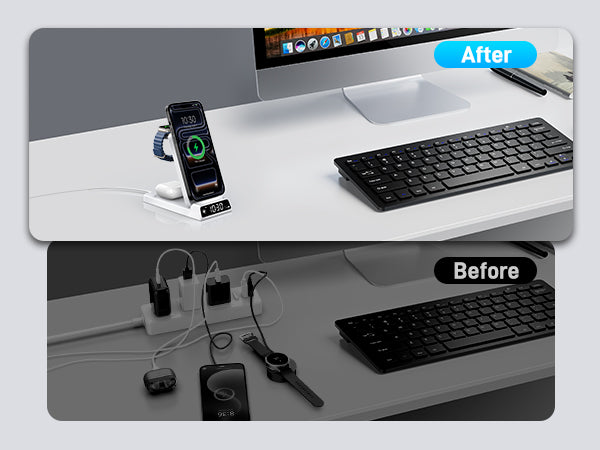
A Qi2.2 3-in-1 charging station powers phone, watch, and earbuds simultaneously — without a single visible cable
1. What Is Qi2.2 — and Why Does the Version Number Matter?
1.1 The Qi Standard: A Quick Backstory
The Qi wireless charging standard, managed by the Wireless Power Consortium (WPC), has been the backbone of wireless charging since 2008. For over a decade, it defined what "wireless charging" meant — primarily through slow, alignment-sensitive pads that required careful positioning. You placed your phone down, waited, and hoped the coil alignment was good enough for a reliable charge.
Our deep dive into Qi wireless charging technology covers the full evolution from WPC's early low-power (5W BPP) offerings to the game-changing introduction of the Extended Power Profile (EPP) at 15W — which for the first time gave Android flagships genuinely fast wireless charging speeds.
1.2 Qi2: The Magnetic Turning Point
Qi2, launched in 2023, introduced the Magnetic Power Profile (MPP) — Apple's MagSafe technology, licensed and standardized under the Qi umbrella. This did two critical things: it standardized alignment via built-in magnets, and it established a quality floor that prevented cheap accessories from delivering poor charging experiences.
But Qi2 launched at 15W — the same ceiling as Apple's first-generation MagSafe. For most users, that was "good enough." For power users with modern flagship phones supporting 45W wired charging, it still felt like a compromise.
1.3 Qi2.2: The Speed Barrier Falls
Qi2.2, formally ratified in early 2026, raises the MPP baseline to 25W. This is not a minor spec bump — it closes the gap with wired charging in a meaningful way. A device that charges from 0% to 50% in 30 minutes via 25W wireless is indistinguishable in real-world experience from the same device plugged into a 25W USB-C charger.
Read more about how magnetic wireless charging technology continues to evolve in 2026, including the engineering breakthroughs that made 25W MPP possible without excessive heat generation.
Why May 2026 Is the Tipping Point
Qi2.2 is more than a specification update. May 2026 sees the simultaneous arrival of: Qi2.2-certified charging pads from major accessory makers, the first wave of Qi2.2-compatible Android flagship firmware updates, and a critical mass of Qi2.2 500+ product certifications — meaning consumers finally have a real market to shop from, not just a spec sheet.
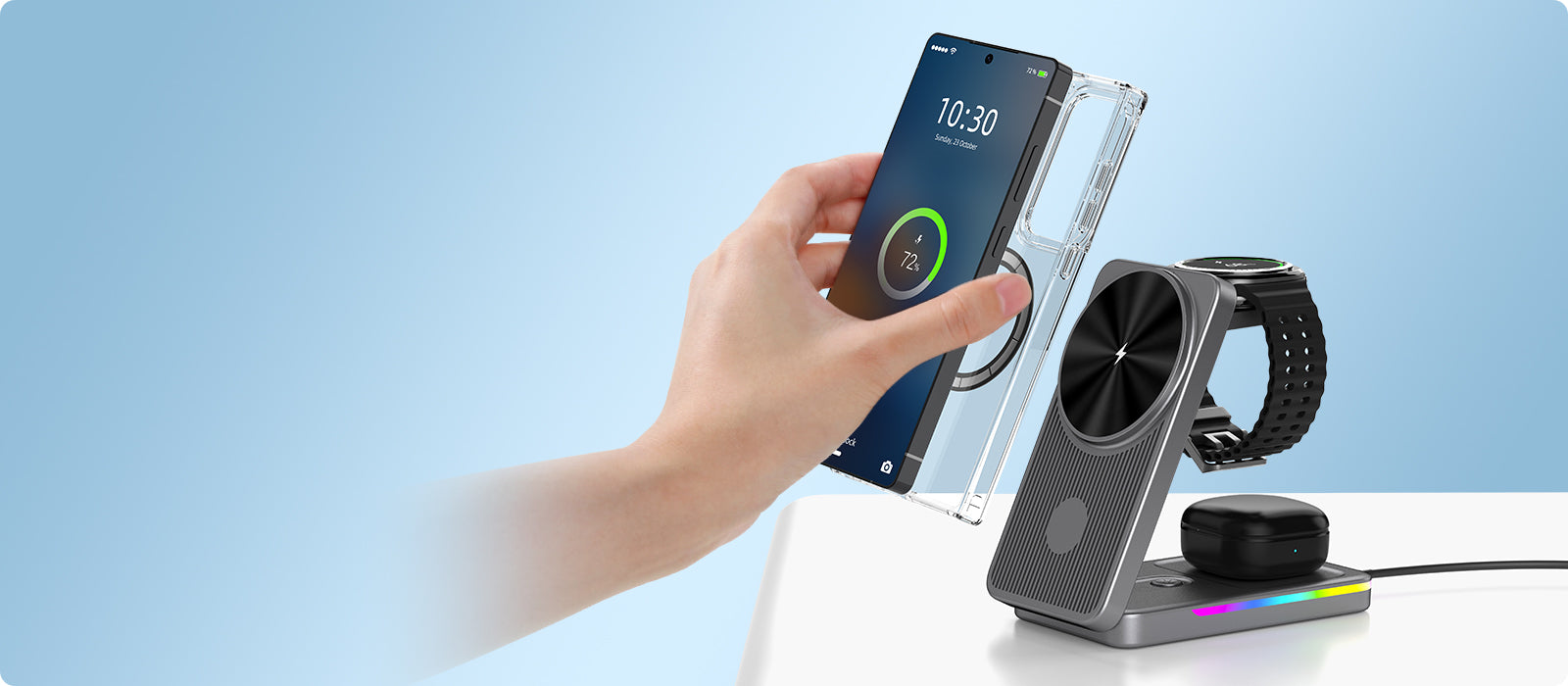
Magnetic alignment eliminates the frustration of misaligned charging coils — the core innovation that made Qi2.2 possible
2. 25W Magnetic: The Numbers That Change Everything
2.1 What 25W Actually Means in Practice
Understanding wireless charging speeds requires translating technical wattage into human experience. Here's what 25W Qi2.2 MPP delivers in real-world terms:
| Charging Scenario | Time (Qi2 15W) | Time (Qi2.2 25W) | Time (45W Wired PD) |
|---|---|---|---|
| 0% → 50% (4,500mAh battery) | ~45 minutes | ~28 minutes | ~25 minutes |
| 0% → 100% (4,500mAh battery) | ~140 minutes | ~90 minutes | ~75 minutes |
| Overnight (8h) → battery wear | Minimal | Minimal (thermal throttling) | None (wired preferred) |
| 30-min top-up during lunch | +30% | +50% | +55% |
The Key Insight
At 25W Qi2.2, the practical difference between wireless and wired is under 15 minutes for a full charge. For overnight charging, this gap is zero — your phone sits on the pad for 8 hours regardless. The old argument that "wireless is too slow for daily use" no longer holds at 25W.
2.2 Thermal Performance: The Quiet Win
One of the biggest criticisms of high-wattage wireless charging has always been heat. Excessive heat degrades battery longevity and causes throttling — reducing actual charging speed below the rated wattage. Qi2.2 addresses this through:
- Dual-coil architecture: Spreading power across two coils reduces localized heat build-up
- Improved Foreign Object Detection (FOD): Faster, more accurate detection of metal objects prevents safety throttling mid-charge
- Active cooling integration: Premium Qi2.2 pads now include micro-fans, keeping coil temperatures under 38°C even at sustained 25W
- Dynamic power negotiation: Devices and chargers continuously communicate to adjust output in real time based on temperature data
3. How Qi2.2 Compares to Your Current Chargers
3.1 Qi2.2 vs. Legacy Qi (5W/15W EPP)
For users upgrading from a first-generation wireless charging pad, Qi2.2 25W represents a 5× improvement in charging speed. For MagSafe users, it's a more modest but meaningful 67% boost.
| Metric | 5W Qi BPP (Legacy) | 15W Qi EPP / MagSafe | Qi2.2 25W MPP |
|---|---|---|---|
| Power output | 5W | 15W | 25W |
| Magnetic alignment | ❌ No | ✅ Yes (MPP/MagSafe) | ✅ Yes |
| Full charge time (4,500mAh) | ~5–6 hours | ~2.5 hours | ~90 minutes |
| Device heat during charging | Low | Moderate | Low (with active cooling) |
| Certified accessory availability | High (older market) | High | Growing rapidly (2026) |
3.2 Qi2.2 vs. 45W USB-C Wired Charging
The wired-vs-wireless debate is now closer than ever. 45W USB-C Power Delivery remains the fastest standard for users who need to charge rapidly and simultaneously use their device. But the trade-off is cable management, connector wear, and the constant plugging/unplugging ritual.
For the vast majority of daily charging scenarios — overnight, desk work, car commutes — Qi2.2 eliminates the friction of cables with a negligible speed penalty. As our complete Qi2 and MagSafe desk setup guide for 2026 explains, the smart move is a hybrid approach: Qi2.2 for daily desk charging, and 45W wired for travel or when you need maximum speed.

Dual-coil Qi2.2 design ensures consistent charging regardless of how you place your device — the end of overnight charging anxiety
4. The Devices You Can Charge Wirelessly Right Now
4.1 Qi2.2 25W — Confirmed Device Support (May 2026)
The 2026 flagship landscape is defined by Qi2.2 compatibility. Here is the confirmed list of devices receiving or natively shipping with Qi2.2 25W MPP support:
- Samsung Galaxy S26 Ultra / S26+: Qi2.2 certified, 25W MPP native support via firmware update (March–April 2026)
- Google Pixel 10 Pro: Qi2.2 native, 23W certified (marginal difference from 25W in practice)
- Apple iPhone 18 Pro series: Qi2.2 MPP 25W, backward compatible with MagSafe accessories
- Sony Xperia 2 VI: Qi2.2 certified flagship with 25W wireless
- OnePlus 14 Pro: SuperVOOC wireless + Qi2.2 25W dual-mode support
- Samsung Galaxy Z Fold 8: Qi2.2 certified — critical for foldable users with limited wired port durability
4.2 Apple's Foldable iPhone — The Qi2.2 Wildcard
The rumored iPhone Fold (Ultra), expected in late 2026, changes the charging dynamic entirely for Apple users. Foldables place unique demands on wireless charging — the battery is split, heat management is more complex, and the folding form factor makes wired charging awkward.
MagSafe was already essential for foldable alignment, but Qi2.2 25W makes it indispensable. For desk setups, a Qi2.2 pad eliminates the need to open and close the foldable just to plug in a cable. Our analysis of the folding iPhone Ultra's ecosystem implications explores how Apple's supply chain synergies — particularly in MagSafe component manufacturing — create a win-win where MagSafe standardization across the iPhone lineup drives down accessory costs for everyone.
4.3 Smartwatches and Earbuds: The 3-in-1 Revolution
Qi2.2 isn't just about phones. The standard's Extended Power Profile (EPP) 25W simultaneously powers:
- Smartwatches: Apple Watch Ultra 3 (Qi2.2 certified), Samsung Galaxy Watch 8 (25W wireless charging case)
- TWS earbuds: AirPods Pro 4, Samsung Galaxy Buds 3 Pro, Sony WF-1000XM6 — all charge via standard Qi2.2 transmitter
- Tablets: iPad Pro M4 (Qi2.2 compatible via rear glass charging, firmware-enabled)
One pad. Three devices. Zero cables. This is the efficiency and technology convergence that industry analysts predicted — and it's finally here.
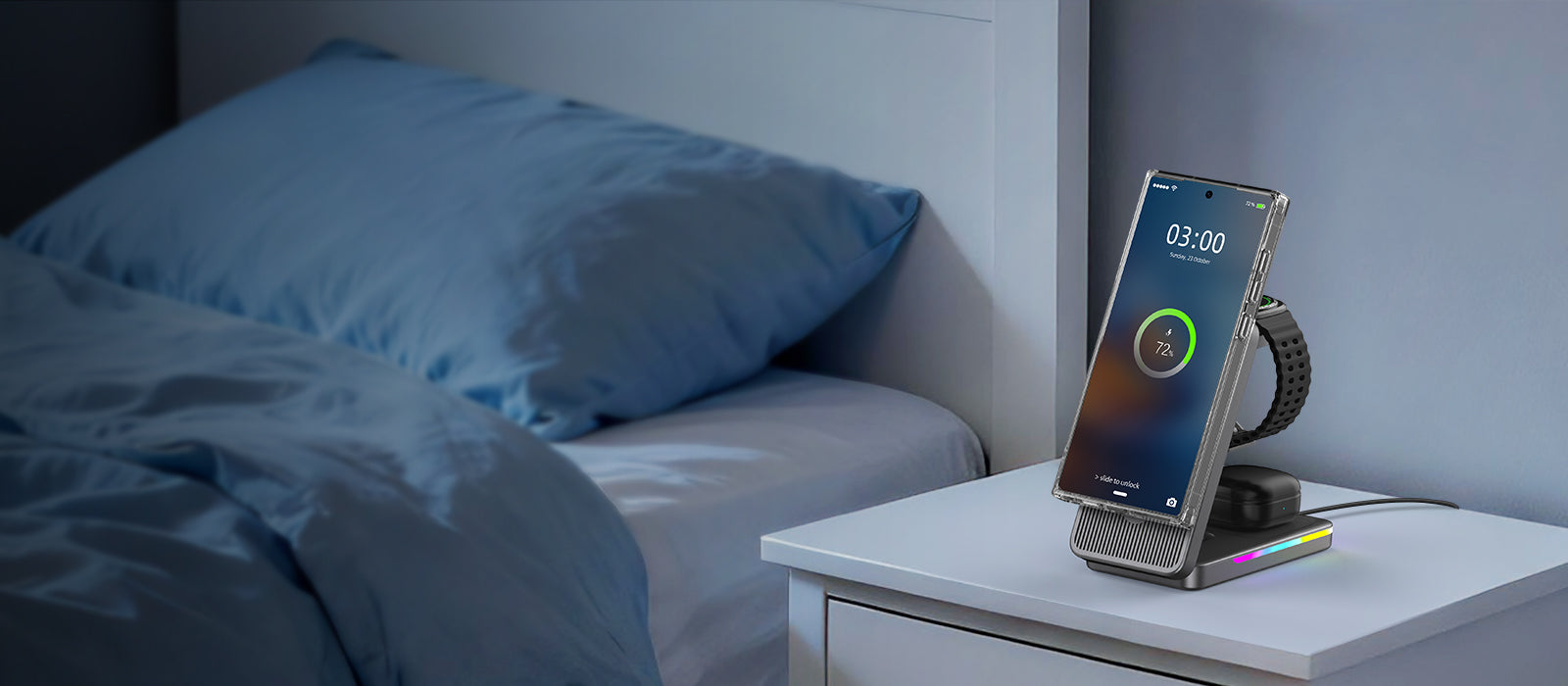
A 3-in-1 Qi2.2 charging station doubles as a bedroom accent piece — wireless charging is finally a design choice, not just a functional one
5. Real-World Desk Setup: From 4 Cables to Zero
5.1 The Typical Desk Cable Audit (2023–2025)
Before Qi2.2, a professional's desk with a laptop, phone, smartwatch, and earbuds required:
- 1 USB-C laptop charger (45–96W)
- 1 phone charging cable (USB-C to USB-C)
- 1 Apple Watch charging puck (proprietary magnetic)
- 1 TWS earbuds case cable (USB-C or Lightning)
That's 4 cables minimum, plus the associated power adapters, power strip congestion, and cable management frustration. For remote workers who move between home office, hotel, and co-working space, multiply that by 3 locations.
5.2 The Qi2.2 3-in-1 Solution
One Qi2.2-certified 3-in-1 charging station — with separate charging zones for phone (25W MPP), Apple Watch / Galaxy Watch (5W EPP), and earbuds (15W EPP) — replaces all four charging cables. The only cable remaining is the station's own power cord, which routes invisibly behind the desk.
The Math: Cable Reduction Impact
| Item | Before Qi2.2 | After Qi2.2 |
|---|---|---|
| Active charging cables on desk | 3–4 cables | 0 cables |
| Power adapters in use | 2–4 adapters | 1 adapter (station) |
| Cable management components needed | Extensive (ties, clips, sleeves) | Minimal (1 routing point) |
| Charging friction (plug/unplug count/day) | 8–12 actions | 2–3 actions (pick up / place down) |
| Desk visual cleanliness score (1–10) | 4–5 | 8–9 |
5.3 Business Travel: The 25W Magnetic Power Bank
The 2026 Qi2.2 wave extends beyond desk pads. Portable Qi2.2 25W magnetic power banks — roughly the size of a flagship smartphone — now deliver the same charging speed as a wired charger, magnetically attached to the back of your phone. For business travelers, this means:
- One compact device replaces both a wired power bank and a wireless charging pad
- Airport lounge charging without fishing for cables
- Hotel nightstand charging without your original charging cable
This is the convergence that our 2026 desk charging setup guide identifies as the key driver for business travel adoption — the 25W magnetic power bank is now a default recommendation for any frequent traveler carrying a Qi2.2 device.

Premium foldable Qi2.2 stations collapse for travel, delivering the same 3-in-1 capability whether you're at your desk or on the road
6. Qi2.2 and the Future: What's Coming After 25W
6.1 Qi2.2's Certification Milestone: 500+ Products
May 2026 sees the Qi2.2 standard cross a critical threshold: over 500 certified Qi2.2 products in the WPC database. This is not just a milestone — it's a signal. Certification volume determines accessory market depth: the more certified products, the lower the price floor drops and the faster retail availability expands beyond specialist electronics retailers into mainstream consumer channels.
6.2 The Road to 50W and Spatial Charging
Qi2.2 at 25W is a landing point, not a destination. The WPC's roadmap points to:
- Qi2.3 (est. 2027): 50W Extended Power Profile — tablet and laptop wireless charging becomes viable
- Spatial Wireless Power: Near-field charging at a distance (up to 1 meter from transmitter), eliminating the "place on pad" requirement entirely. The AuraCharge spatial charging platform is the first commercial implementation.
- Multi-device spatial charging: One transmitter charging multiple devices in a room simultaneously, without alignment
The magnetic charging innovation landscape in 2026 makes clear that Qi2.2's 25W is the bridge technology that builds consumer confidence and accessory ecosystem maturity for the even more transformative spatial power era.
7. Your Desk, Reimagined — A Practical Guide
7.1 The One-Station Rule
If you do nothing else after reading this article, commit to one change: replace your multi-cable desk charging situation with one Qi2.2-certified 3-in-1 station. Place it where you naturally set your phone during work hours. The magnetic alignment means it's ready to use immediately. Within 48 hours, you'll have unconsciously integrated it into your workflow — and you'll never want to go back to cables.
7.2 Choosing the Right Qi2.2 Station
Not all Qi2.2 stations are equal. Key selection criteria for May 2026:
| Feature | Minimum Standard | Recommended | Premium |
|---|---|---|---|
| Phone charging (MPP) | 15W Qi2 | 25W Qi2.2 | 25W Qi2.2 + active cooling |
| Magnetic alignment | Required (MPP) | Required | Strong neodymium magnets |
| Watch charging zone | Qi EPP 5W | 5W dedicated coil | 5W + Apple Watch fast charge |
| Watch compatibility | Qi BPP fallback | Apple Watch + Galaxy Watch | All major watch brands |
| USB passthrough | None | 1× USB-C (15W) | 2× USB-C (30W total) |
| Foldable / travel | No | Optional | Yes, compact foldable design |
7.3 The Hybrid Charging Stack
The optimal 2026 desk charging strategy isn't "wireless only" — it's wireless as default, wired as backup:
- Primary desk charger: Qi2.2 3-in-1 station (phone + watch + earbuds, always-on)
- Secondary wired port: 65W GaN USB-C hub (laptop + secondary device charging via cable)
- Portable backup: 25W Qi2.2 magnetic power bank (for travel and commute)
- Old cables: Keep one in your bag for emergency airport/hotel charging scenarios
The Elecdov Recommendation
For professionals running a multi-device ecosystem — particularly mixed Apple + Android households or those transitioning to a foldable device — the Qi2.2 3-in-1 charging station is the single highest-ROI desk upgrade of 2026. The cable elimination alone transforms the visual and functional quality of your workspace, and the 25W speed parity with wired charging removes every remaining justification for the cable clutter.
Core Q&A
Q1: Is Qi2.2 25W actually as fast as a 25W wired charger?
Yes, in practice. Wireless charging efficiency is typically 75–85%, meaning the phone receives 19–21W of the 25W transmitted. A wired 25W charger delivers the full 25W. The real-world charging time difference is under 10 minutes for a full charge cycle on a 4,500mAh battery — negligible for daily use. Thermal throttling on premium Qi2.2 pads with active cooling further minimizes the gap.
Q2: Can I use my old MagSafe charger with a Qi2.2 phone?
Yes, with caveats. Qi2.2 is backward compatible with Qi2 (15W MPP) and MagSafe accessories. Your old MagSafe charger will work on a Qi2.2 phone at 15W. You won't get the 25W speed until you upgrade to a Qi2.2-certified charger. Conversely, a Qi2.2 charger will work with an older Qi2 phone at the phone's maximum supported wattage.
Q3: Does wireless charging damage battery health faster than wired?
At Qi2.2 25W with thermal management, no. The heat generated by Qi2.2 charging with active cooling pads is comparable to moderate 25W wired charging. Both benefit from the same battery management systems that regulate charging current based on temperature. The old concern about wireless charging "overheating" batteries applied to early 5W pads without thermal management — a problem the Qi2.2 ecosystem has largely solved.
Q4: Is Qi2.2 worth upgrading from a Qi2 15W setup?
For power users, yes. The 67% speed improvement (15W → 25W) is most valuable if you frequently do rapid top-ups rather than overnight charging. If you primarily charge your phone overnight, the upgrade is less urgent — but the improved heat management and magnetic strength of Qi2.2 certified accessories still make it worthwhile. If you charge midday or during short sessions, the difference is significant.
Q5: Will Qi2.2 charge my laptop?
Not yet at practical levels. Qi2.2 25W can technically maintain a laptop's battery during light use, but it cannot charge a laptop from low battery at meaningful speed. Laptop wireless charging (estimated 50W Qi2.3, 2027) is the target for future desk charging scenarios. For now, USB-C Power Delivery at 65W–96W remains the standard for laptop charging.
Q6: How do I know if a charger is genuinely Qi2.2 certified?
Check the WPC database. The Wireless Power Consortium maintains a public product registry at www.wirelesspowerconsortium.com. Look for the Qi2.2 symbol with "MPP 25W" designation on the product's certification label. Generic chargers claiming "Qi2 compatible 25W" without WPC certification may deliver lower actual wattage, poor heat management, or incompatible magnetic alignment.

Elecdov Technical Team
Retail, Wholesale, Customization, After-sales, Repair, Joint Cooperation, One-stop Service
Ready to build your Qi2.2 cable-free desk?
Explore our full range of Qi2.2 certified charging stations, power banks, and travel chargers.
Get Free Charging Setup Consultation


