
iPhone Air Meets MagSafe: Designing the Wireless Nightstand for the Ultra-Thin Era
Quick Navigation
Introduction
On April 7, 2026, Apple's online store quietly updated its iPhone lineup with a new entry: iPhone Air. At 5.5mm thick, it's the thinnest smartphone Apple has ever produced. And somewhere in the product bullet points was a detail that mattered more than most people realized: iPhone Air comes with MagSafe and ships with Apple's dedicated iPhone Air MagSafe Battery accessory for RMB 799.
Coupled with the announcement that iPhone 17e — Apple's entry-level model — now features MagSafe for the first time, delivering 15W magnetic wireless charging and compatibility with Apple's full ecosystem of magnetic accessories, a picture emerged: 2026 is the year MagSafe completed its transition from premium feature to standard expectation.
For the bedroom charging space — that small rectangle of nightstand real estate where phones go to sleep — this shift matters profoundly. An ultra-thin phone with magnetic charging demands a different aesthetic approach. The clunky charging stands of yesterday look increasingly dated next to a device that's barely half a centimeter thick.
This article explores how the iPhone Air and the broader MagSafe ecosystem are reshaping the nightstand — and what it means to design a charging space that's both functional and beautiful.
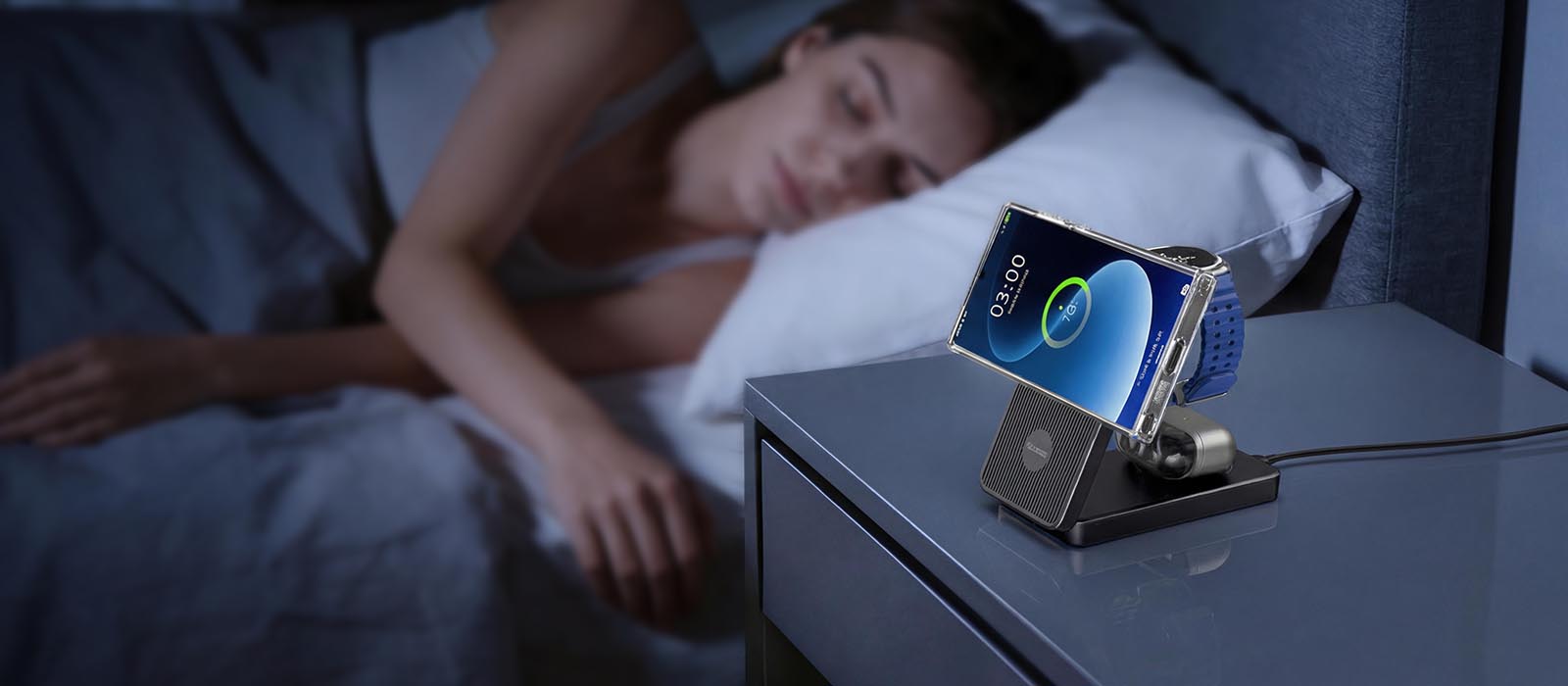
The modern nightstand: where MagSafe meets minimalist design
Chapter 1: The 5.5mm Phone That Changes Everything
When Thinness Becomes Identity
Apple's iPhone Air isn't just a thinner iPhone — it's a statement about what matters in smartphone design in 2026. The phone abandons the camera bump that defined iPhones for the past five years. It compromises on speaker quality and camera specifications to achieve its silhouette. And yet, Apple is pricing it at approximately $900, positioning it as a premium product, not a budget compromise.
What does this have to do with wireless charging? Everything. A 5.5mm phone doesn't rest comfortably on a thick, plastic wireless charging pad. The visual dissonance is immediate: a sleek, minimalist device sitting on a chunky, utilitarian charger. The iPhone Air demands a charging aesthetic that matches its identity.
More importantly, Apple reportedly considered making iPhone Air a portless device — the first iPhone without a charging port, powered entirely by wireless charging. That decision was ultimately scrapped, but the fact that it was seriously considered reveals Apple's trajectory: the future of iPhone charging is wireless, and the charging accessories need to evolve to match.
MagSafe for Everyone: The iPhone 17e Democratization
While tech enthusiasts debate the iPhone Air's compromises, a quieter revolution happened in the entry-level tier: the iPhone 17e now includes MagSafe magnetic charging.
For years, entry-level iPhones supported Qi wireless charging but lacked the magnetic alignment of MagSafe. This meant iPhone SE and budget iPhone users couldn't use magnetic wallets, stands, or charging mounts. With iPhone 17e, Apple has extended MagSafe compatibility across the entire iPhone lineup.
The implications for bedroom charging are significant:
- Universal magnetic accessory compatibility — Every new iPhone owner can use the same stands, docks, and magnetic mounts
- 15W wireless charging standard — Entry-level users now get the same wireless charging speed as premium models
- Magnetic ecosystem expansion — Magnetic wallets, stands, and car mounts work across the entire product line
The bedroom charging space can now be designed around a single standard: MagSafe magnetic alignment works for every iPhone from the 17e to the iPhone Air to the iPhone 17 Pro Max.
The MagSafe Battery for iPhone Air: A New Form Factor
The iPhone Air MagSafe Battery (RMB 799) is Apple's first dedicated magnetic battery pack designed specifically for a single device. Unlike previous MagSafe Battery Packs that worked across multiple iPhone models, this accessory is tuned precisely for the iPhone Air's ultra-thin profile.
What makes this relevant to bedroom aesthetics is the design language: The iPhone Air MagSafe Battery is as slim as the phone itself, creating a continuous silhouette when attached. There's no visual interruption between phone and battery. This is the aesthetic the entire bedroom charging ecosystem should aspire to: accessories that look like they belong to the device, not accessories that attach to it.
 Magnetic charging that complements, not competes with, your device's design
Chapter 2: The Nightstand as a Charging Canvas
The Death of the Cable Nightstand
The traditional nightstand charging experience was defined by a single object: the Lightning cable. It draped across the nightstand, collected dust, frayed at the connector, and required a precise angle to plug in half-asleep. For years, this was accepted as normal.
Wireless charging promised to kill the cable. But in bedroom contexts, the first generation of wireless chargers created new problems:
- Placement anxiety — Did the phone actually start charging? The absence of a physical connection meant no tactile confirmation.
- Alignment frustration — Qi chargers without magnetic alignment required precise placement. Half-asleep placement often meant no charge.
- Slow charging speeds — 5W and 7.5W Qi charging felt slower than the wired experience it replaced.
MagSafe and Qi2 have solved all three problems simultaneously. Magnetic alignment provides visual and tactile confirmation. The 15W (and now 25W with Qi2.2) charging speeds match or exceed wired charging for typical overnight scenarios. The nightstand can finally be cable-free without compromise.
Designing the Aesthetic Nightstand Charging Setup
The ideal nightstand charging setup in 2026 prioritizes three things: visual harmony, functional reliability, and ambient integration.
Visual Harmony: The charger should look like it belongs on the nightstand, not on a tech desk. This means:
- Material matching — If your nightstand is wood, choose a charger with wood or fabric accents. Metal nightstands pair with aluminum chargers.
- Color restraint — White, black, or natural tones. Avoid neon LEDs and bold brand colors that clash with bedroom aesthetics.
- Form factor fluidity — A flat pad that the phone rests on horizontally (for bedside StandBy mode) or a low-profile stand that doesn't dominate the nightstand visually.
Functional Reliability: The charger must work every time, without thought. This means:
- Magnetic alignment — Non-negotiable. If it doesn't have magnets, it doesn't belong on a nightstand.
- Overnight charging intelligence — Smart chargers that slow down after 80% to preserve battery health, then complete the charge cycle before you wake.
- Ambient light management — LED indicators should be dimmable or turn off completely. Bright charging lights are sleep enemies.
Ambient Integration: The charger should feel like part of the room's design, not an alien object. This means:
- Nightstand size proportion — A small nightstand needs a compact charger. A large nightstand can accommodate a multi-device station.
- Cable management — The charger's power cable should route cleanly, not snake across the nightstand surface.
- StandBy mode optimization — For iPhone, horizontal charging activates StandBy: a clock, photo frame, or widget display. The charger should support this orientation elegantly.
The StandBy Transformation: Nightstand to Smart Display
Apple's StandBy mode, introduced in iOS 17 and refined through iOS 19 in 2026, transforms the charging phone into a bedside smart display. When an iPhone charges horizontally on a MagSafe stand, it can show:
- Time and date — A digital clock display
- Photos — A slideshow from your photo library
- Widgets — Weather, calendar, reminders
- Smart home controls — HomeKit device toggles
This transformation means the phone charger is no longer just a power delivery device — it's a display stand. The aesthetic quality of the stand directly affects the aesthetic quality of the information displayed on your phone every night. A cheap, wobbly stand means a poorly oriented clock. A quality stand means a stable, beautiful display.
 A well-designed charging stand supports StandBy mode and complements your nightstand aesthetic
Chapter 3: AirPods Pro 3 and the Charging Ecosystem
The Magnetic Charging Case Evolution
AirPods Pro 3, featured prominently in Apple's MagSafe accessories page in 2026, represents the continuing evolution of Apple's audio + charging synergy. The charging case now features MagSafe alignment magnets, allowing it to snap onto any MagSafe charger or Qi2 pad.
For the bedroom charging ecosystem, this means:
- Unified charging surface — A single 3-in-1 MagSafe charger can handle iPhone, AirPods Pro 3, and Apple Watch
- Consistent aesthetic — The charging location for AirPods matches the charging location for iPhone: on a magnetic pad, not a separate USB-C puck
- Simplified cable management — One charging cable for multiple devices, not separate cables for phone, earbuds, and watch
The Apple Watch Independence Problem (and Solution)
The one device that doesn't fit cleanly into the magnetic alignment ecosystem is the Apple Watch. Its charging puck remains proprietary, with a unique coil configuration that doesn't align with Qi2 or MagSafe standards.
This creates an aesthetic challenge: the nightstand needs a dedicated space for the Apple Watch puck, which doesn't match the other charging surfaces. The solutions:
- Integrated 3-in-1 stands — Many MagSafe 3-in-1 chargers include a dedicated Apple Watch puck holder. The watch charges separately, but the stand keeps everything visually unified.
- Nightstand mode optimization — The Apple Watch, when on its charger, can display a nightstand clock. Position the watch charger so this clock is visible from bed.
- Minimalist acceptance — Accept that the watch needs its own charger and design around it. Some nightstands have a dedicated drawer or shelf for watch charging.
The aesthetic ideal: an integrated 3-in-1 stand where the phone charges horizontally (StandBy mode), the AirPods charge on a dedicated magnetic zone, and the Apple Watch has its own puck holder integrated into the stand's design.
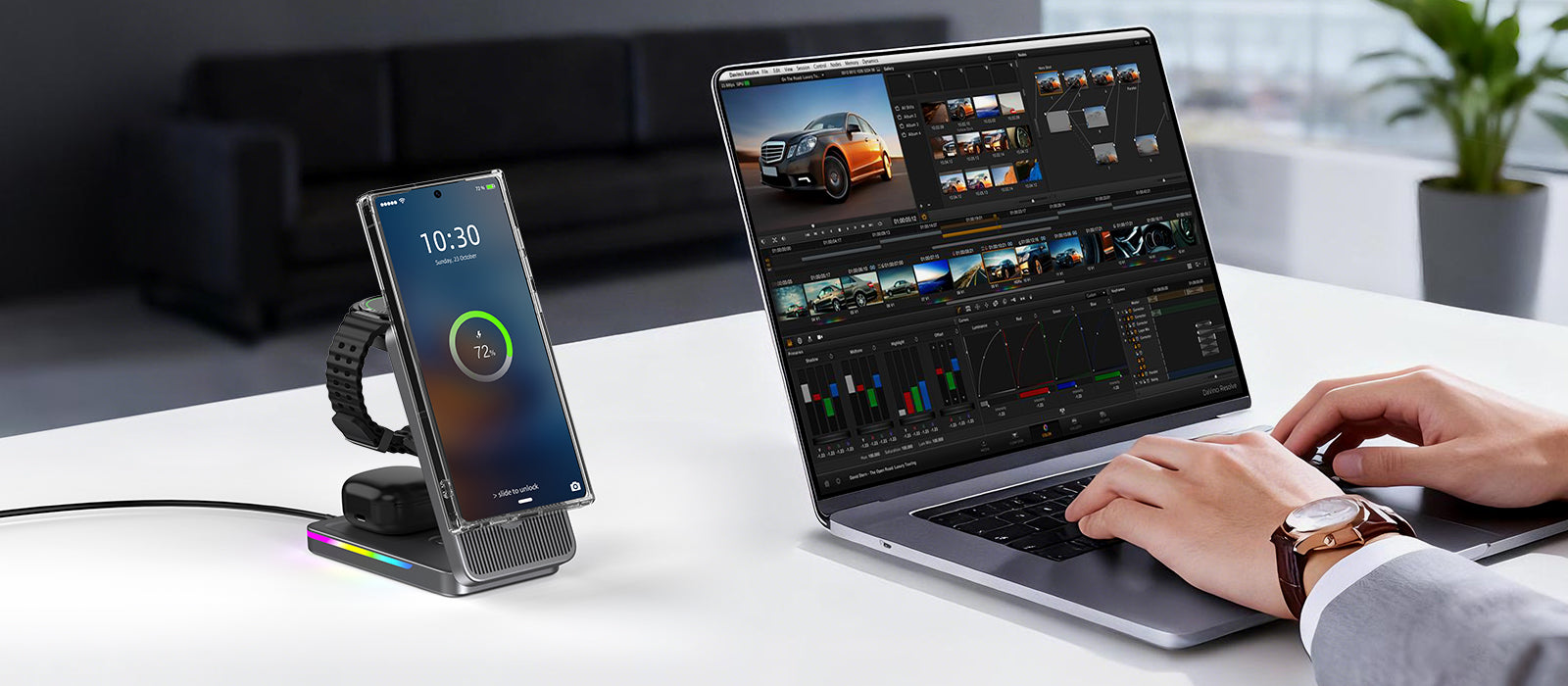
Integrated 3-in-1 stands unify your charging ecosystem into a single, beautiful object
Chapter 4: Building the Aesthetic Charging Space
The Minimalist Nightstand: Less Charging, More Living
The ultimate goal of bedroom charging design isn't the charger itself — it's the absence of charging as a visual concern. A well-designed nightstand charging setup should be so integrated that you barely notice it. The phone charges while you sleep. The earbuds charge while you sleep. The watch charges while you sleep. And when you wake, everything is ready.
The path to this minimalism:
- Choose a 3-in-1 charger in your aesthetic — Look for materials and colors that match your nightstand and bedroom decor.
- Route cables invisibly — Use cable management clips, routing channels, or even drill a hole through the nightstand if possible. The cable should disappear, not snake across surfaces.
- Embrace StandBy mode — Let your phone become a clock while it charges. This turns the charging setup into a functional bedroom element, not clutter.
- Consider integrated furniture — Some modern nightstands include built-in wireless charging surfaces, eliminating visible chargers entirely.
- Use ambient lighting wisely — If your charger has LED indicators, ensure they can be dimmed or disabled. Sleep quality matters more than charging status lights.
The iPhone Air Nightstand: Specific Considerations
For iPhone Air owners, the 5.5mm thickness creates specific design requirements:
- Charger thickness matters — A thick, chunky charger will look comically mismatched with the iPhone Air. Choose ultra-slim charging pads or low-profile stands.
- Magnetic strength — The iPhone Air may have smaller magnets due to its thin profile. Ensure your charger has strong enough magnetic alignment to hold securely.
- Horizontal charging optimization — The iPhone Air's ultra-wide aspect ratio makes StandBy mode particularly striking. Prioritize chargers that support stable horizontal positioning.
- The iPhone Air MagSafe Battery integration — If you use Apple's magnetic battery, your charger needs to accommodate the phone + battery combo, which doubles the effective thickness.
Fabric, Wood, and Material Choices
The best bedroom chargers don't look like tech products — they look like furniture. Material choices that blend with bedroom aesthetics:
| Material | Best For | Considerations |
|---|---|---|
| Fabric-wrapped | Soft, warm bedrooms | May show dust over time; hard to clean |
| Wood veneer | Traditional, natural spaces | Matches wood furniture; premium aesthetic |
| Matte plastic | Modern, minimalist rooms | Neutral colors; doesn't conduct heat |
| Aluminum | Contemporary, tech bedrooms | Excellent thermal management; may feel "cold" |
| Silicone/polymer | Families, durability focus | Easy to clean; withstands drops |
 Material choices that complement your space, not compete with it
Conclusion
The iPhone Air and MagSafe's expansion to entry-level iPhones signal a fundamental shift: wireless charging is no longer a tech feature — it's an aesthetic expectation. The devices we bring into our bedrooms in 2026 are designed around magnetic charging, and the charging accessories we choose should match that design language.
The 5.5mm iPhone Air doesn't just look different — it demands a different charging relationship. The nightstand is no longer a place for cables and plastic pads. It's a canvas for integrated, beautiful charging that enhances the space rather than cluttering it.
For anyone designing a bedroom charging setup in 2026, the priorities are clear: magnetic alignment (non-negotiable), aesthetic integration (critical), and multi-device unification (essential). The MagSafe ecosystem — now spanning every iPhone from the 17e to the Air to the Pro Max — provides the technical foundation. The design choices are yours.
The bedroom should be a place of rest, not of charging anxiety. With MagSafe and Qi2, it finally can be.
Looking for nightstand-friendly wireless charging solutions that match your aesthetic? Browse Elecdov's curated collection of Qi2-certified charging stations — designed to blend into your space, not dominate it.
Core Q&A
Does iPhone Air work with existing MagSafe chargers?
Yes. iPhone Air includes MagSafe magnets and will work with any existing MagSafe or Qi2 charger. However, the magnetic strength may be slightly different due to the phone's thinner profile. Apple's dedicated iPhone Air MagSafe Battery is tuned specifically for this device, but standard MagSafe accessories remain fully compatible.
Should I buy a dedicated nightstand charger or a multi-device station?
For most people, a 3-in-1 MagSafe charging station is the best choice. It handles iPhone, AirPods, and Apple Watch from a single device with one cable. However, if you only charge your phone at the bedside (and your watch and earbuds charge elsewhere), a simple MagSafe stand may suffice. Consider your device mix and choose accordingly.
How do I stop my charger's LED from disrupting my sleep?
Look for chargers with dimmable or defeatable LED indicators. Many Qi2 and MagSafe chargers have an "ambient mode" that dims LEDs at night. If your charger doesn't offer this, placing a small piece of tape over the LED or positioning the charger so the LED faces away from the bed are practical workarounds.
Are integrated wireless charging nightstands worth the investment?
For new furniture purchases, integrated charging nightstands offer the cleanest aesthetic — no visible chargers at all. However, they may be locked into specific charging standards. As Qi2.2 emerges, an integrated Qi2 charging surface may become outdated faster than a separate charger. If you value flexibility, a high-quality 3-in-1 charger at分离d from the furniture is the more future-proof choice.
Does iPhone 17e's MagSafe work with all MagSafe accessories?
Yes. iPhone 17e's MagSafe implementation includes the same magnetic alignment system as premium iPhones. It works with magnetic wallets, stands, car mounts, and charging pads at 15W. The democratization of MagSafe means any accessory designed for MagSafe will work across the entire iPhone lineup in 2026.
What's the best charger orientation for StandBy mode: vertical or horizontal?
Horizontal (lying flat) is the ideal orientation for StandBy mode, as it allows for the largest display area and the most flexibility in viewing angle. A charger that sits flat on the nightstand, with the phone resting horizontally on top, optimizes StandBy mode. Vertical stands can also trigger StandBy but may position the phone at angles that aren't ideal for viewing from bed.
Related Articles
- The Complete Bedroom Wireless Charging Design Guide — From nightstand materials to cable management, everything you need to know
- Qi2 vs MagSafe for Home Charging — Which standard is right for your living space?
- AirPods Pro 3 MagSafe Case: Feature or Necessity? — How magnetic charging transformed wireless earbuds

Elecdov Technical Team
Retail, Wholesale, Customization, After-sales, Repair, Joint Cooperation, One-stop Service
Design your perfect nightstand charging setup
Elecdov's aesthetic charging collections blend into your bedroom, not clutter it.
Browse Charging Solutions


