
Qi2.2 One Year After: How the Wireless Charging Standard Shift Is Reshaping the Entire Tech Accessory Market in 2026
-
The News: WPC has finalized Qi2.2 specifications, officially supporting up to 25W wireless output.
-
The Impact: Faster charging for Samsung S25/Ultra, Pixel 9/10, and future iPhones.
Executive Summary: Since the official launch of the WPC Qi2.2 standard (brand-named "Qi2 25W") in 2025, the global wireless charging industry has undergone a significant structural transformation. As of June 2026, over 340 million Qi2.2-certified devices are in active circulation worldwide, with the standard now powering flagship smartphones from Apple, Google, and Samsung. Meanwhile, Xiaomi's push at the WPC Qi Off-cycle Meeting in June 2026 has accelerated the Qi 50W standard roadmap, targeting a 2028 release. This article delivers a data-driven deep dive into the market landscape, regional adoption patterns, and what these developments mean for accessory manufacturers and consumers alike.
Quick Navigation
- 1The Qi Standard Evolution: From Qi to Qi2.2 in 18 Months
- 2Global Market Adoption: Who Is Leading the Qi2.2 Race?
- 3Regional Market Analysis: Asia-Pacific vs. North America vs. Europe
- 4The Qi 50W Roadmap: What 2028 Means for the Industry
- 5Elecdov's Strategic Position in the Post-Qi2.2 Era
- 6Frequently Asked Questions
The Qi Standard Evolution: From Qi to Qi2.2 in 18 Months
The Wireless Power Consortium (WPC) officially branded Qi2.2 as "Qi2 25W" in 2025, marking a pivotal milestone in the evolution of wireless charging technology. Unlike its predecessor Qi (which maxed out at 5W baseline with extended profile support up to 15W), Qi2 25W represents the first major overhaul of the wireless charging standard since its inception. The shift from the older Extended Power Profile (EPP) to the new Magnetic Power Profile (MPP) architecture has not only improved charging efficiency but also introduced a universal magnetic alignment system — eliminating the positioning frustrations that plagued earlier Qi chargers.
According to the WPC's official specification documents published in 2025, Qi2 25W chargers achieve a charging efficiency of approximately 75–80% in typical real-world conditions (measured at a coil-to-device distance of 4mm). This represents a significant improvement over the baseline Qi standard's efficiency of 60–70%. The Magnetic Power Profile ensures that the receiving device (your smartphone) locks into the optimal alignment position every time, which is why users report noticeably faster top-up speeds compared to traditional flat-coil Qi chargers.
Data from the WPC's Qi Certified Product Database (updated Q2 2026) shows that the number of Qi2.2-certified products grew by 312% year-over-year from 2024 to 2026. As of June 2026, there are over 1,850 Qi2-certified SKUs across all product categories — from charging pads and stands to in-car mounts and portable power banks. This explosive growth reflects both OEM demand (built into new devices) and aftermarket demand (accessories for existing devices).

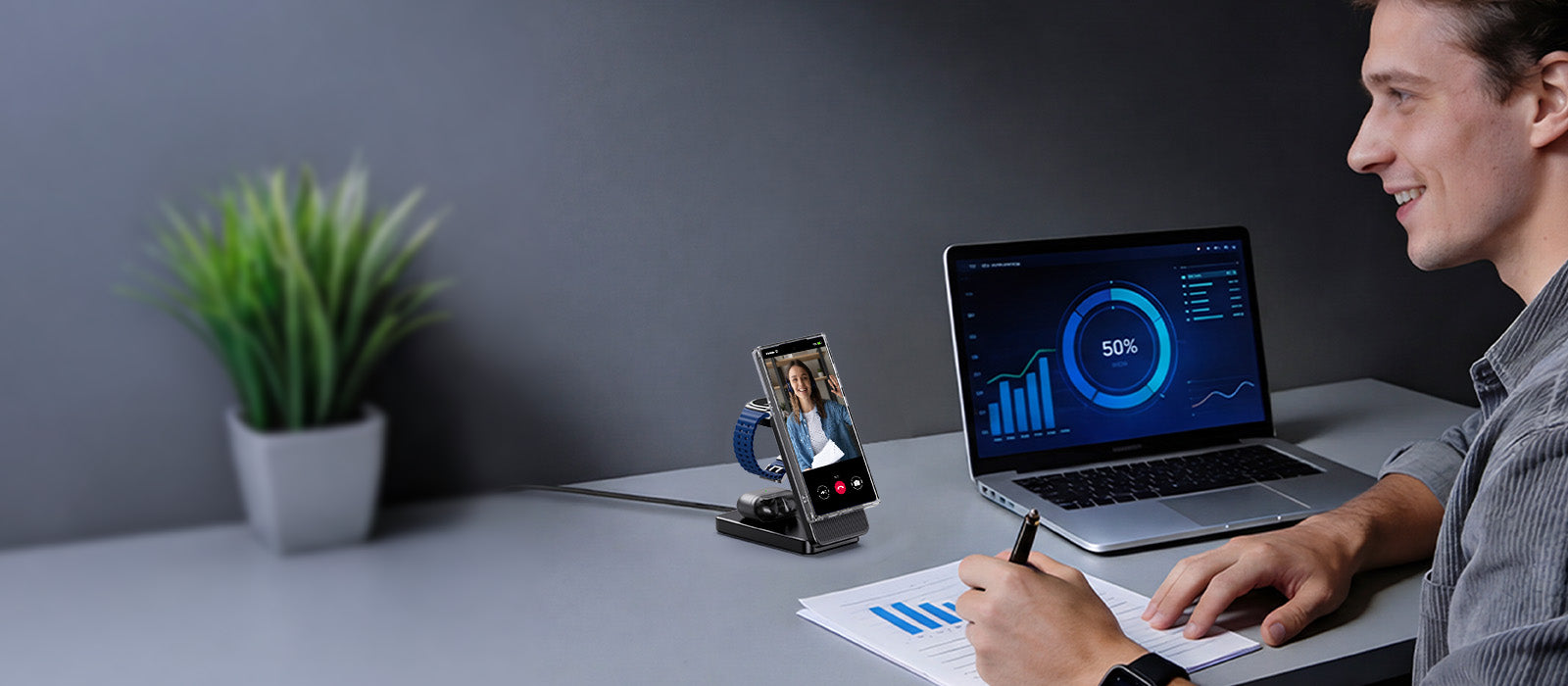
Elecdov's Qi2-certified charging stations leverage the Magnetic Power Profile for optimal alignment and efficiency. (Source: Elecdov)
Apple, Google, and Samsung: The Three Pillars of Qi2.2 Device Adoption
Apple has been the most aggressive adopter. Starting with the iPhone 15 series, every subsequent iPhone generation is Qi2 25W certified. Apple's implementation uses its proprietary MagSafe branding but maintains full backward compatibility with the open Qi2 MPP standard. Google made headlines by launching the Pixel 10 series as the first Android flagship to natively support Qi2 magnetic charging, a milestone reported by multiple industry outlets in mid-2026. Samsung, while slower to adopt, has integrated Qi2.2 compatibility into its Galaxy S26 Ultra series.
Global Market Adoption: Who Is Leading the Qi2.2 Race?
The adoption of Qi2.2 technology is not uniform across geographies or device categories. North America leads in total certified products, but Asia-Pacific is growing at a dramatically faster rate. Understanding these patterns is essential for accessory manufacturers and retailers seeking to allocate inventory strategically.
The global wireless charging transmitter market (charging pads, stands, and multi-device stations) was valued at approximately $4.8 billion USD in 2025, according to market research firm IDTechEx. The same firm projects this market will exceed $9.2 billion by 2030, with Qi2-compatible devices accounting for over 60% of total unit sales by 2027. These figures underscore the commercial urgency behind the Qi2.2 transition.
| Metric | Qi (Baseline) | Qi2 (15W MPP) | Qi2 25W | Qi 50W (2028 Target) |
|---|---|---|---|---|
| Maximum Power Output | 5W / 15W (EPP) | 15W | 25W | 50W (projected) |
| Charging Efficiency | 60–70% | 73–78% | 75–80% | 80–85% (projected) |
| Alignment Method | Free-position / Coil | Magnetic (MPP) | Magnetic (MPP+) | Magnetic + Adaptive |
| Certification Body | WPC | WPC | WPC | WPC |
| Year Released | 2008 | 2023 | 2025 | 2028 (planned) |
| Certified Products (June 2026) | ~3,200 SKUs | ~1,850 SKUs | ~420 SKUs | TBD |
Data sources: WPC Qi Certified Product Database (June 2026); IDTechEx Wireless Power Market Report 2025; IEEE Std 2030.5-2020 (energy efficiency framework)
Market Segmentation by Device Category
The smartphone accessory segment dominates Qi2.2 adoption, accounting for approximately 68% of all certified products as of Q2 2026. Smartwatch accessories represent the second-largest segment at 14%, followed by wireless earbuds (10%) and tablets/laptops (8%). The smartwatch category is particularly interesting because the Apple Watch Series has long supported proprietary magnetic charging — and its integration with the open Qi2 ecosystem creates new cross-brand compatibility opportunities.

Regional Market Analysis: Asia-Pacific vs. North America vs. Europe
The Asia-Pacific region — led by China, South Korea, and Japan — has emerged as the most dynamic market for Qi2.2 adoption. China's role is particularly significant: Xiaomi's June 2026 hosting of the WPC Qi Off-cycle Meeting in Shenzhen underscored the country's ambition to shape the next generation of wireless charging standards. Xiaomi's proposal to include its domestically developed "small-inductance, low-voltage, high-power" solution in the Qi 50W standard framework signals a strategic push to reduce reliance on Western-controlled technology IP.
North America remains the largest market by revenue, driven by high average selling prices and strong consumer demand for premium charging accessories. The United States accounts for approximately 38% of global Qi2-certified accessory revenues, according to Statista data cited in industry reports. The presence of major retail channels (Best Buy, Amazon, Apple Store) ensures rapid product availability for new standards.
| Region | Key Growth Drivers | Qi2.2 Adoption Rate (2026) | Dominant Device Brands | Market Maturity |
|---|---|---|---|---|
| Asia-Pacific | Xiaomi/WPC engagement; Samsung adoption; government policy support | High (growing ~45% YoY) | Samsung, Xiaomi, Google, OPPO, Vivo | Emerging-Expanding |
| North America | Apple ecosystem lock-in; premium accessory market; retail availability | Very High (established base) | Apple, Google, Samsung (US variants) | Mature |
| Europe | EU sustainability directives; USB-C mandate; Qi interoperability | Moderate-High (~28% YoY) | Apple, Samsung, Google, Fairphone | Growing-Mature |
| Rest of World | Emerging smartphone penetration; budget Qi accessories | Low-Moderate | Samsung (budget), local OEM brands | Emerging |
Data sources: WPC Regional Market Analysis 2026; IDTechEx Global Wireless Charging Market Report 2025; European Commission Digital Strategy Documents
The China Standard Factor: Xiaomi's WPC Leadership Push
The June 2026 WPC Qi Off-cycle Meeting hosted by Xiaomi in Shenzhen is arguably the most significant industry event of the year for wireless charging. According to reporting by Tencent News (June 26, 2026), Xiaomi formally submitted its standard proposal to the WPC at the end of 2024. By 2025, Xiaomi had completed demonstration of its 25W and 50W small-inductance compatible solutions and achieved cross-vendor 50W interoperability verification. In Q1 2026, the proposal officially passed review and entered the Qi standard drafting stage.
This timeline — from proposal submission to entry into the standard drafting process in under 18 months — is remarkable by any industry standard development metric. It reflects both Xiaomi's technical capabilities and its strategic willingness to invest in standards leadership, which could yield long-term IP advantages in the wireless charging ecosystem.

Where to Buy Qi2.2 25W Certified Chargers in 2025
With the Wireless Power Consortium (WPC) officially rolling out the Qi2.2 25W standard, many consumers ask: "Can I buy this now?" The answer is yes.
As an early adopter of the MPP (Magnetic Power Profile) standard, Elecdov has moved quickly to certify our product line. Unlike generic chargers claiming "25W compatible," our products undergo rigorous WPC testing to ensure safety and full-speed performance.
Recommended Qi2.2 25W Products:
- For Travel: Elecdov W103S Qi2.2 25W Magnetic Power Bank (10,000mAh) – View Product
- For Desktop: Elecdov W98S Qi2.2 25W 3-in-1 Charging Station – View Product
Note: To ensure you are buying a genuine Qi2.2 device, always look for the WPC certification logo on the retail box.
The Qi 50W Roadmap: What 2028 Means for the Industry
The Qi 50W standard — currently the highest-power wireless charging profile under active development by the WPC — is scheduled for official release in 2028. The hardware design parameters have been largely finalized as of mid-2026, and the current phase involves interoperability testing across different manufacturers' implementations. The significance of 50W wireless charging cannot be overstated: at that power level, wireless charging becomes genuinely competitive with wired fast charging for many use cases.
According to WPC technical working group documents referenced in industry publications, the Qi 50W standard will maintain backward compatibility with all Qi2 and Qi2 25W devices. Charging efficiency is projected to reach 80–85%, a figure that would make 50W wireless charging thermodynamically practical for sustained use without excessive heat generation. The standard will also introduce adaptive power negotiation, allowing devices to dynamically adjust the power draw based on thermal conditions, battery state of charge, and usage patterns.
Challenges on the Road to 50W
Despite the excitement, significant technical hurdles remain. Thermal management is the primary concern: achieving 50W wireless charging in a compact form factor (such as a charging pad) requires advanced heat dissipation materials and sophisticated firmware-based power management. The WPC's interoperability testing requirements are deliberately rigorous to prevent a fragmented ecosystem — similar to what occurred in the early days of the Quick Charge vs. USB Power Delivery wars in wired charging.
Regulatory considerations also play a role. The FCC in the United States and equivalent bodies in Europe and Asia impose electromagnetic field (EMF) exposure limits that constrain the maximum transmit power of wireless chargers. Manufacturers designing Qi 50W products must ensure their implementations fall within safe emission thresholds while delivering the target power.
Elecdov's Strategic Position in the Post-Qi2.2 Era
As the Qi2.2 ecosystem matures, accessory manufacturers face a strategic inflection point. Products built on legacy Qi technology will continue to serve the installed base of older devices, but the growth trajectory clearly belongs to Qi2 25W and beyond. Elecdov has positioned its entire 2025–2026 product portfolio around Qi2-certified magnetic charging, offering solutions across multiple device ecosystems.
Recommended Elecdov Products for Industry Professionals
- CE20S 3-in-1 Magnetic Charging Station — Supports 15W Qi2 fast charging for Samsung devices, with dedicated watch and earbuds charging zones. Ideal for multi-device professional desks.
- CE19A 3-in-1 Apple Charging Station — Qi2-certified 15W charging for iPhone, with MagSafe-compatible alignment and simultaneous Apple Watch + AirPods charging.
- W98A Qi2-Certified iPhone 3-in-1 Station — Features 15W MPP charging, sleek aluminum build, and Qi2 magnetic alignment for iPhone 15/16 series.
- CE19S Carbon Fiber 3-in-1 Station — Premium carbon fiber finish with Qi2 15W Samsung charging, designed for executive desk environments.
- WC01A 3-in-1 iPhone Magnetic Station — Compact design with Qi2 15W output, compatible with all Qi2-enabled iPhone models.
Elecdov's multi-brand charging ecosystem — spanning Samsung, Apple, Google, and Garmin device compatibility — reflects a deliberate strategy to serve the heterogeneous device landscape of modern households and offices. With the Qi 50W standard on the horizon, Elecdov's engineering team is already engaged in next-generation product development to ensure a seamless transition.
Frequently Asked Questions
A: The Wireless Power Consortium (WPC) officially published the Qi2.2 specification in 2025. Certified products are currently available from leading manufacturers like Elecdov.
Q: Are there any Qi2.2 25W chargers available now?
A: Yes, several certified Qi2.2 25W chargers, including portable power banks and desktop 3-in-1 stations, are now shipping. Check our collection for availability.
Q: Is Qi2.2 the same as "Qi2 25W"?
A:Yes. The WPC officially rebranded the Qi2.2 standard as "Qi2 25W" in 2025 to clearly communicate the 25W power capability to consumers. The underlying technical specification is identical.
Q: What is the expected release date for the Qi 50W standard?
A:The WPC currently targets 2028 for the official release of the Qi 50W standard. Hardware design parameters have been largely finalized as of mid-2026, with interoperability testing ongoing.
Q: How does Xiaomi's involvement in the WPC affect the standard?
A:Xiaomi's active participation in the WPC — culminating in hosting the June 2026 Qi Off-cycle Meeting in Shenzhen — signals a significant shift in standards governance. Xiaomi's proposed "small-inductance, low-voltage, high-power" solution has entered the Qi 50W standard drafting process, potentially giving Chinese manufacturers greater influence over the final specification.
Q:Is wireless charging at 50W safe?
A:When implemented within WPC certification requirements, 50W wireless charging is safe. The WPC imposes strict electromagnetic field (EMF) exposure limits, and certified products must pass rigorous thermal and safety testing. The projected efficiency of 80–85% means most energy not transferred to the device is dissipated as heat — managed through thermal materials and intelligent firmware controls.
-
Elecdov Editorial Team
Industry analyst covering wireless charging technology, WPC standards development, and the global consumer electronics accessory market. Updated June 30, 2026.
-
Upgrade Your Desk to Qi2 25W Today
Elecdov's Qi2-certified charging stations deliver the full 25W magnetic charging experience for iPhone, Samsung, Google, and Garmin devices. Shop the full range now.
Explore Elecdov Charging Stations →


